
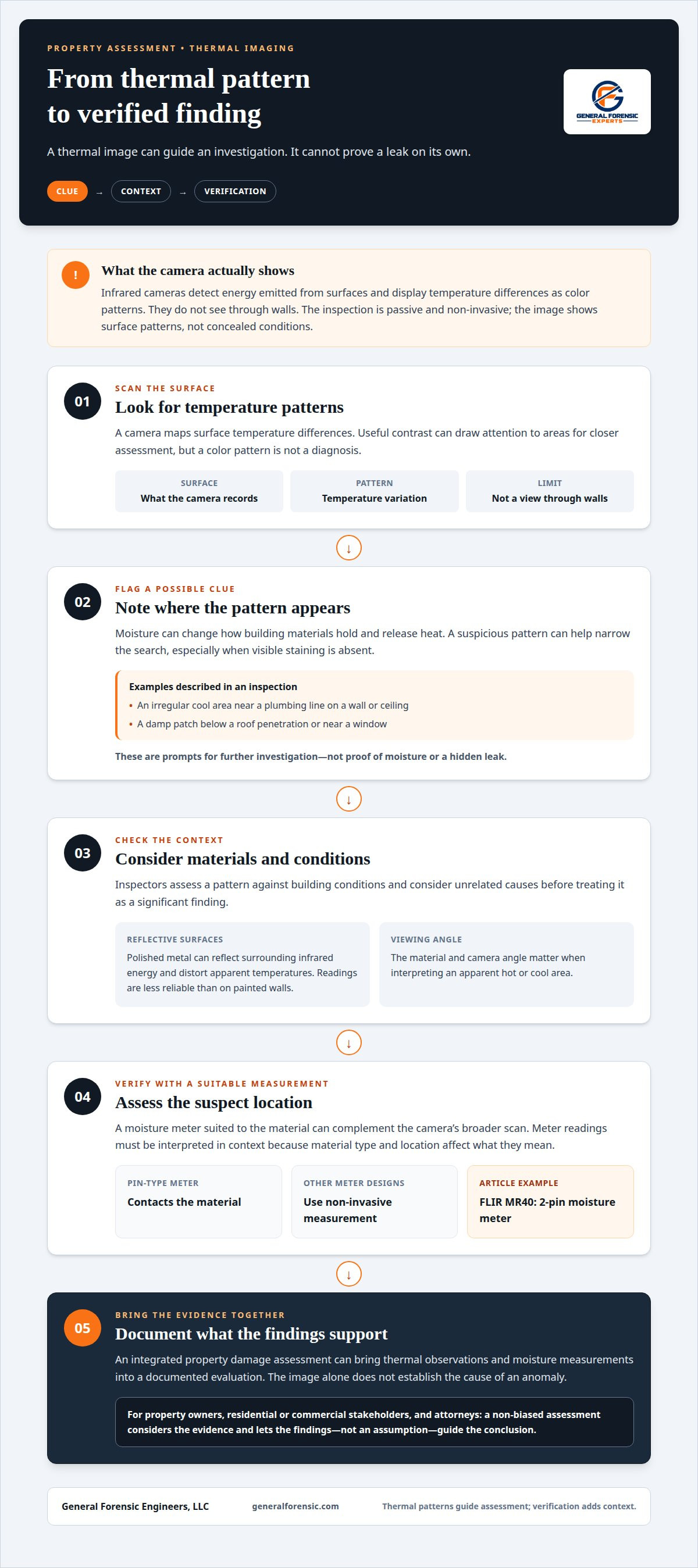
FLIR Thermal Imaging Property Inspections: Reading Images for Leak Clues
A thermal image can reveal a temperature pattern, but it cannot prove a leak on its own. A FLIR thermal imaging property inspection records infrared energy emitted from surfaces and displays temperature differences as color patterns. It does not see through walls. An unusual area is a clue to investigate, not a diagnosis.
That distinction matters when moisture or a concealed leak is suspected. Temperature patterns can point to areas that warrant closer assessment, while building conditions and other evidence help determine what the image indicates.
This article explains how thermal imaging can reveal possible moisture clues, why camera distance and field of view affect an image, and how to interpret warm or cool areas without treating every anomaly as damage. The result is a clearer understanding of what an inspection can reveal and what requires further evaluation.
Table of Contents
What is a Thermal Imaging Home Inspection?
A FLIR thermal imaging property inspection uses a camera to map surface temperature patterns without opening walls. The images help identify areas for closer investigation, but they do not establish the cause of a leak.
Infrared Heat Signatures and Surface Patterns
An infrared camera detects energy emitted from surfaces and converts temperature differences into visible color gradients. Warm or cool patterns can indicate changes associated with air movement or other thermal conditions. The camera does not see through walls like an X-ray machine, so its image shows surface patterns, not concealed conditions.
This non-invasive, passive process means the camera emits no radiation. Its observations can guide further assessment without disturbing finishes.
Effects of Shiny Materials on Readings
Shiny materials, including polished metal, can reflect surrounding infrared energy and distort apparent temperature readings. Their low emissivity makes measurements less reliable than readings from painted walls. Reflections may create misleading hot or cool areas, so the material and camera angle matter when interpreting an image.
This limitation is especially relevant when a suspected anomaly appears on a reflective surface. The image alone cannot establish the surface’s actual temperature or confirm moisture.
Infrared-Guided Measurement and MSX Imaging
Infrared-guided measurement uses a thermal image to direct attention to an area for further assessment. FLIR’s MR277 combines infrared-guided measurement, MSX imaging, and environmental sensors. MSX adds visual detail to thermal imagery, helping relate a temperature pattern to visible building features.
These functions add context to observations, but they do not independently determine an anomaly’s cause.
Choosing FLIR Cameras and Inspectors
FLIR Ex Pro-Series, E8 Pro, and MR277 are camera examples; suitable equipment depends on the target and required detail. A qualified thermographer or home inspector should explain image limitations and document how observations relate to building conditions. A FLIR thermal imaging property inspection is a diagnostic method, not a determination of code compliance; requirements depend on the project and applicable jurisdiction.
Useful temperature contrast between indoors and outdoors can support clearer patterns. Before inspection, provide access to relevant rooms and areas of concern. Inspection cost depends on property size, access, and scope. Limitations include reflections and ambiguous patterns, which may require further assessment.
Using thermal imaging to identify possible hidden moisture and leaks
Moisture changes how building materials hold and release heat, creating patterns that can guide closer investigation. Thermal imaging helps locate suspicious areas, while other measurements help assess whether moisture is present.
Thermal Sensitivity for Moisture and Pest Detection
A camera’s thermal sensitivity determines how clearly it distinguishes small surface-temperature differences. Subtle moisture patterns may require a higher-performance camera, particularly when the affected area is small or temperature contrast is limited. The image can direct an inspector to a wall, ceiling, or floor area for further assessment.
Thermal patterns can also point to other conditions. Large subterranean termite infestations inside wall cavities may produce metabolic heat and moisture detectable by sensitive cameras. That pattern is a prompt for investigation, not a stand-alone pest diagnosis.
Examples of Moisture and Leak Anomalies
A leak near a plumbing line may produce an irregular cool area on a wall or ceiling as moisture changes the surface’s thermal behavior. A damp patch below a roof penetration or near a window may also stand out from surrounding materials. These patterns help narrow the search, especially when visible staining is absent.
A thermal anomaly does not, by itself, establish moisture or a hidden leak. Inspectors assess the pattern against building conditions and may rule out unrelated causes before treating it as a significant finding.
Verification uses a moisture meter suited to the material under examination. A meter can assess moisture at a suspect location, complementing the camera’s broader scan; pin-type meters contact the material, while other meter designs use non-invasive measurement. FLIR’s MR40 is a 2-pin moisture meter. A reading is interpreted in context, since material type and location affect what it means.
For a property with unexplained thermal patterns, an integrated property damage assessment can bring image observations and moisture measurements into a documented evaluation.
Camera field of view and target distance
A thermal camera’s field of view determines how much of a scene appears in one image. Distance affects how much of the target fits in that view and how clearly its pattern can be assessed. A wide field of view suits nearby surfaces, such as a room wall, while a narrower view can help examine a small, distant target.
Consider a ceiling viewed from below. From close range, a wide-angle camera may capture a broad section, including surrounding framing and fixtures. That context can help locate a temperature anomaly in the room. From farther away, the same area occupies less of the image, making small features harder to distinguish. Moving closer may reveal more detail, but it can also exclude surrounding surfaces needed for comparison.
For a small target, such as a narrow area around a pipe penetration, a narrower field of view may make the target occupy more of the image from a distance. The camera must still be aimed carefully. If the target falls near the edge or is partly blocked by a beam, the image may not show its full pattern. A wider view can document the surrounding ceiling, while a closer view can focus on the suspected area.
Distance and viewing angle also affect comparisons between images. A wall scan taken from across a room cannot be directly compared with a close view unless the location and conditions are understood. For consistent interpretation, the inspector records the target location, camera position, and nearby reference surfaces. A suspected cool patch beside a window, for example, is more meaningful when compared with adjacent wall areas.
Field of view is a practical choice, not a measure of certainty. Framing depends on whether the inspection needs broad coverage, detail on a small target, or both. A useful assessment may combine a room-wide image with a closer view to preserve both the location context and the thermal pattern under review.
Interpreting thermal images during home inspections
A thermal image records a temperature pattern, not its cause. Interpretation requires comparing the pattern with building features, operating conditions, and other inspection evidence before drawing a conclusion.
For suspected air leakage, an inspector considers whether a warm or cool pattern follows likely paths around windows, doors, penetrations, or building joints. Thermal imaging can help locate air leakage, but the image alone does not establish its source. A pattern may reflect airflow, insulation conditions, surface materials, or another temperature difference. Its location and consistency with surrounding conditions help give the finding meaning.
Electrical equipment requires a separate reading. Service panels are scanned under normal household load so the inspector can assess temperature patterns during operation. A hot spot may draw attention to a circuit or connection, but heat alone does not establish a defect. Electrical equipment commonly warms under load. The inspector considers patterns across components and the panel’s operating context rather than labeling every warm area a failure.
Image quality also affects the conclusion. Uncertain FLIR images should be reviewed on a larger screen before a final determination or inclusion in a report. A wider display can make boundaries, surrounding features, and subtle pattern differences easier to assess. The inspector then relates the image to the building area and supporting measurements, rather than treating color contrast as a diagnosis.
A defensible interpretation distinguishes observation from inference. The observation might be a localized temperature difference at a ceiling joint. The inference must account for plausible causes and available corroboration. If the evidence does not establish a specific cause, the report should describe the anomaly precisely rather than overstate what the image proves. This approach limits unnecessary destructive work prompted by a misread hot or cool spot.
For an impartial assessment of property conditions and documented findings, request a property inspection.
General Forensic Engineers
General Forensic Engineers, LLC helps property owners, residential and commercial stakeholders, and attorneys assess building conditions through objective property inspections and expert forensic damage assessments. When thermal images reveal an unexplained pattern, an assessment can consider that observation alongside other evidence and examine possible causes without presuming the outcome.
This work is relevant when suspected moisture, leaks, or property damage call for a clearer account of observed conditions. Findings can help stakeholders understand what the inspection supports, what remains uncertain, and whether additional assessment is warranted. For attorneys, an independent technical evaluation can inform the factual understanding of a property dispute without replacing legal representation or insurance claim adjusting.
Turn Thermal Findings Into a Clear Assessment
A FLIR thermal imaging property inspection can provide useful evidence, but its value depends on evaluating observations alongside the property’s condition. When moisture concerns intersect with a property damage dispute, an impartial assessment can help clarify what the evidence supports and where further investigation may be warranted.
General Forensic Engineers, LLC provides Expert Forensic Damage Assessment and Residential & Commercial Property Inspections, as well as Pre & Post-Commercial Property Hurricane Assessments. These assessments help property owners and commercial stakeholders understand documented building conditions without presuming what the findings will show.
Plaintiff’s attorneys evaluating a property damage matter can contact General Forensic Engineers, LLC to discuss an impartial property assessment that helps establish the relevant facts.
Frequently Asked Questions
What can FLIR thermal imaging detect during a property inspection?
It can reveal surface-temperature patterns associated with air movement, insulation irregularities, moisture, or heat from operating equipment. For example, an unusual ceiling pattern beneath a bathroom may help focus further investigation. The image cannot establish which condition caused the pattern or reveal concealed damage directly. Inspectors interpret it alongside the property’s visible condition and other relevant observations.
How does a FLIR thermal camera property inspection work?
The inspector scans selected surfaces and records thermal images showing temperature differences across the property. These images help identify locations for closer examination, such as a ceiling near plumbing or a section of exterior wall. The inspector considers the location and surrounding conditions, then uses appropriate additional assessment to evaluate the observation. The camera provides diagnostic information, not a stand-alone conclusion.
What factors affect the accuracy of thermal imaging in home inspections?
Surface material, reflections, camera distance, field of view, and temperature contrast can affect how clearly an image represents a target. Polished metal, for example, can reflect surrounding infrared energy and distort apparent readings. A small target may also occupy too little of an image when viewed from far away. Inspectors account for these factors before relying on a thermal pattern.
Can FLIR thermal imaging detect water leaks, insulation gaps, and electrical problems?
It can identify temperature anomalies that may direct attention to suspected leaks, insulation irregularities, or electrical hot spots. A cool area near plumbing, for instance, can warrant further moisture assessment, while a warm panel component may merit closer examination under normal operating conditions. Neither pattern proves a defect on its own. Additional evidence is needed to assess the cause and significance.
How does FLIR thermal imaging compare with moisture meters and other inspection methods?
Thermal imaging surveys surface patterns across an area, while a moisture meter provides readings at selected material locations. Used together, they can help narrow an investigation and assess a suspected damp area. Visual inspection supplies building context that neither instrument provides alone. Throughout Florida cities like Miami, Tampa, and St. Petersburg, property conditions guide which assessment methods are relevant to a professional evaluation by General Forensic Engineers, LLC.
What weather and temperature conditions are best for thermal imaging a property?
Useful temperature contrast between indoors and outdoors can produce clearer thermal patterns.
Comments