
Forensic Engineering Litigation Support for Legal Teams
A forensic engineer’s value in litigation depends on more than a title. Forensic engineering litigation support applies engineering principles to investigate failures, identify likely causes, and explain technical findings in a legal dispute. The American Society of Civil Engineers’ definition includes investigating failures or performance problems and, when required, testifying about findings.
Attorneys need evidence-based analysis, not advocacy for a preferred outcome. A qualified expert brings competence in the disputed subject, forensic investigation, and litigation support, then communicates conclusions clearly and objectively. ASCE guidance also makes clear that a specific academic degree in forensic engineering does not establish competence.
This article explains how an investigation traces root causes, how technical evidence can inform responsibility, and which qualifications matter when selecting an engineer to support a case. It also outlines how General Forensic Engineers helps property owners, commercial stakeholders, and legal teams assess property damage through forensic investigation and expert witness services.
Table of Contents
WHAT IS FORENSIC ENGINEERING?
Forensic engineering applies engineering analysis to failures and performance problems connected to legal disputes. The American Society of Civil Engineers describes testimony as part of the work when findings must be presented in court or another judicial forum.
Expert Witness Testimony
An expert witness explains technical findings, the evidence behind them, and how the analysis connects observed damage to possible causes. Testimony may clarify engineering concepts for a judge or jury. The expert’s ability to explain limitations and address contrary evidence matters as much as technical detail. For example, a building failure analysis should distinguish observed conditions from opinions about their causes.
There is no single typical expert witness fee or hourly rate. Fees depend on the assignment’s scope, technical discipline, site work, testing, reporting, and testimony preparation; pricing is provided after a quote request.
Independence and Credibility
Credible analysis records observations that support or challenge an initial theory. A forensic engineer should allow conclusions to evolve as evidence develops, rather than adopting a position because a party, attorney, or insurance interest prefers it. Project experience should also match the subject, such as building-envelope damage, structural distress, or water intrusion.
Attorneys can find firms serving the property’s location, then assess whether their engineering expertise and project experience fit the disputed failure. The ability to explain methods and conclusions in testimony is another relevant criterion.
Litigation Support Services
Forensic engineering litigation support can include examining a property, analyzing records and physical evidence, identifying likely causes, preparing a technical report, and explaining findings in testimony. The scope depends on the dispute and evidence available. A thorough investigation may also distinguish damage mechanisms from later repairs or conditions unrelated to the claimed event.
For property disputes, relevant experience may include residential or commercial building assessments, hurricane damage, or structural performance problems. Attorneys and property stakeholders can use the resulting analysis to understand technical issues and evaluate how evidence informs the case, without treating an engineer’s opinion as a legal determination of responsibility.
Forensic engineering investigation and root-cause analysis
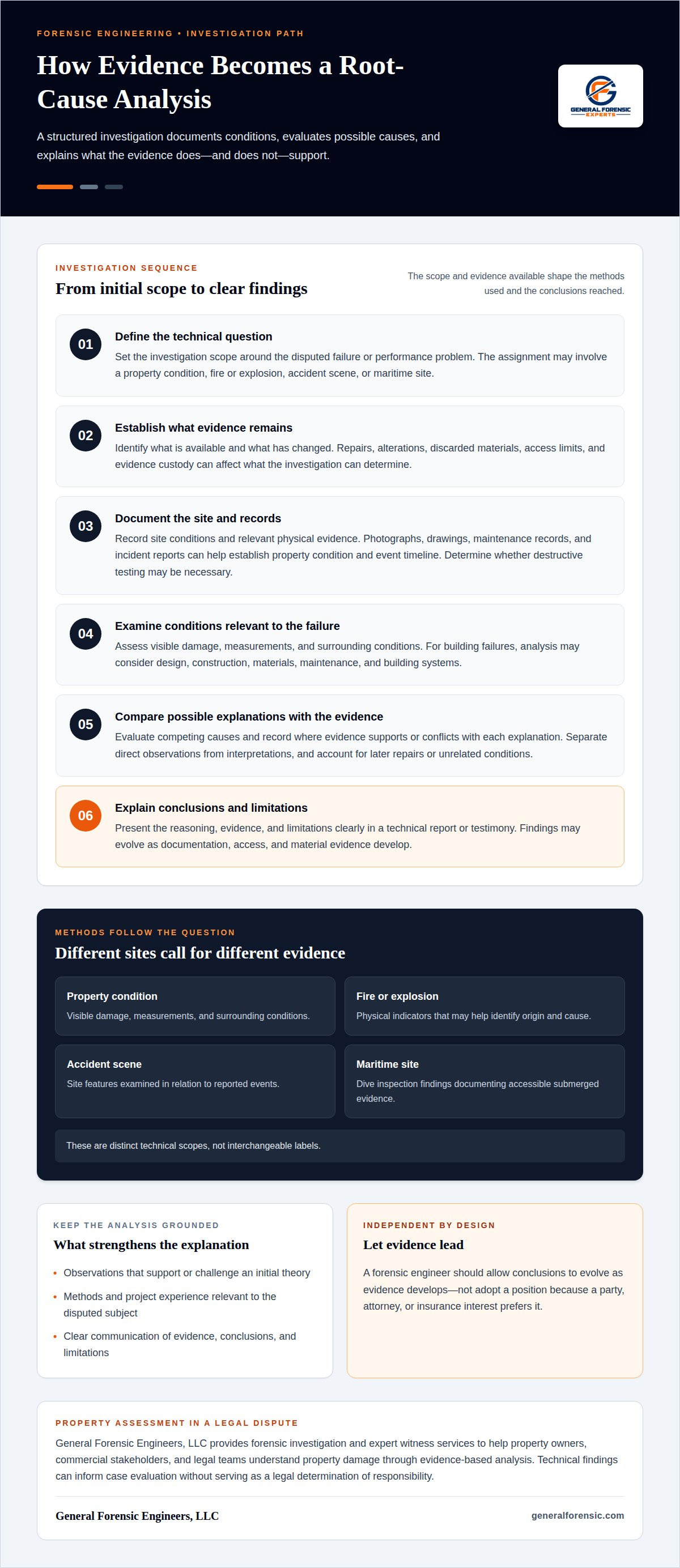
A sound investigation starts with physical evidence, not an assumed cause. Forensic engineering litigation support begins by defining the technical scope, recording site conditions, and testing whether damage supports a proposed explanation. Findings can change as documentation, access, and material evidence develop.
Before examining a property, the engineer establishes what evidence remains available and what has changed. Repairs, alterations, or discarded materials can affect conclusions. The engineer identifies evidence custody, access limits, and whether destructive testing may be necessary. Photographs, drawings, maintenance records, and incident reports help establish the property’s condition and event timeline. Early coordination about preserving evidence can reduce later disputes over missing or changed materials.
Investigation scope and methods
Different assignments require different methods. A civil condition assessment may examine structural movement, water intrusion, or building components. Fire and explosion investigations evaluate origin indicators and damage patterns. Accident investigations analyze physical conditions related to an incident. Maritime investigations may include dive inspections when relevant evidence is underwater. These are distinct technical scopes, not interchangeable labels.
Property condition: Document visible damage, measurements, and surrounding conditions.
Fire or explosion: Assess physical indicators that may help identify origin and cause.
Accident scene: Record site features and examine how they relate to reported events.
Maritime site: Use dive inspection findings to document accessible submerged evidence.
For each scope, the engineer compares competing explanations against the evidence and records limitations. For example, a roof assessment after a storm considers damage patterns alongside photographs, maintenance records, and repair history. The analysis separates direct observations from interpretations, then explains how evidence supports or conflicts with each proposed cause. Forensic engineering litigation support uses this documented reasoning to help stakeholders understand claims without presuming whose position the findings will support.
For building damage disputes, an independent property damage assessment can document conditions and examine causation through a structured investigation.
Establishing responsibility for structural failures
Responsibility depends on technical findings, not the severity of visible damage alone. A forensic engineer evaluates how design, construction, materials, maintenance, and building systems may have contributed.
Florida Building Failures and Assessments
For a Florida property, a structural assessment documents affected components, the pattern of distress, and conditions that may have influenced performance. The engineer examines available plans, construction records, maintenance history, and physical evidence. These sources help distinguish a design or construction issue from deterioration, a later alteration, or another contributing condition.
Attorneys can use clear findings to identify which technical questions need further analysis. A licensed, experienced forensic engineer may help assess whether a builder, engineer, contractor, or another party bears some or all responsibility. The assessment informs the technical record, but does not itself decide legal liability.
Structural Failures and Building Collapses
A collapse investigation examines the failure sequence, not just the final condition. The engineer evaluates damaged structural elements, connections, load paths, and available construction documentation. Electrical or mechanical failures may also matter if they affected structural components or building performance. Each proposed cause must be tested against physical evidence.
In a partial collapse, for example, investigators may compare damage across connected areas to determine where failure began and how it spread. Expert witness services can explain technical conclusions in terms attorneys and decision-makers can understand. The analysis depends on a traceable connection between evidence, method, and conclusion.
Structural Distress and Building Failures
Cracking, deformation, settlement, or separation can indicate structural distress, but each condition needs context. An engineer records its location, extent, and relationship to adjacent components, then considers whether the pattern aligns with movement, material failure, construction defects, or another mechanism. A crack by itself does not establish who caused the condition.
Attorneys should look for findings that separate direct observations from engineering opinions and explain the limits of available evidence. This distinction helps property owners and commercial stakeholders understand how competing explanations affect responsibility. A careful assessment may support or challenge a claim, regardless of which party benefits from the result.
Forensic engineer qualifications
A strong forensic engineer combines relevant technical competence with disciplined investigative practice. The American Society of Civil Engineers’ Guidelines for Forensic Engineering Practice emphasize competence in the assignment’s subject, investigation, analysis, and reporting. A degree titled “forensic engineering” is not the defining qualification. Specialized programs are not generally offered, and competence does not depend on one specific academic degree.
For structural failures, attorneys should assess whether the engineer’s education, professional experience, and project history match the disputed system. A Professional Engineer license is a relevant credential, but does not alone establish expertise in every technical field. Experience with building structures, materials, or the failure mechanism involved provides more useful context.
Attorneys choose between a forensic engineer, accident reconstructionist, and other expert witnesses by matching the assignment to each expert’s technical discipline. Structural or building-system failures call for relevant engineering competence; incident dynamics may require an accident reconstructionist. Complex disputes may need multiple specialists with clearly defined scopes.
Subject fit: Confirm that the expert has worked with the building system or failure mechanism involved.
Method: Review how the expert tests explanations and connects observations to conclusions.
Communication: Assess whether the expert can explain technical analysis clearly in reports and testimony.
Impartiality: Look for documented observations, including evidence that challenges an initial theory.
For expert testimony, methods should be scientifically sound, testable, and consistent with accepted protocols. The Daubert standard concerns the relevance and reliability of expert testimony in court. A detailed expert report should explain the methods used, evidence considered, reasoning, and limitations. Clearly disclosing uncertainty or contrary evidence strengthens the transparency of the analysis.
ASCE guidance also calls for engineers to explain their opinions and conclusions, whether or not they testify. An attorney evaluating an expert should consider the ability to withstand technical scrutiny and communicate findings to non-engineers. To discuss an expert forensic damage assessment, provide the property and dispute context.
General Forensic Engineers
General Forensic Engineers, LLC helps attorneys, property owners, and residential or commercial stakeholders assess building damage through impartial technical investigation. Its work examines evidence and documents findings without assuming which party those findings will support.
When a property failure or damage dispute calls for an independent assessment, Expert Forensic Damage Assessment can help clarify observed conditions and possible causes. Residential and commercial property inspections, recertification and milestone inspections, and pre- and post-commercial property hurricane assessments address other property evaluation needs.
These services provide technical information for stakeholders considering next steps; they do not replace legal advice or determine legal responsibility. Attorneys can use an assessment to understand property evidence, while owners gain a clearer record of the property’s condition.
Move the Technical Record Forward
A property dispute is easier to evaluate when its technical questions are defined before positions harden. Forensic engineering litigation support can help legal teams connect available evidence to the issues that matter, while allowing findings to challenge an initial theory. Its value lies in what an investigation substantiates, not in which party expects a particular result.
For attorneys and property owners, a practical next step is to identify the damaged property, the event or condition at issue, and the decision an assessment needs to inform. General Forensic Engineers, LLC can explain how an impartial property evaluation addresses that need. Contact the firm to discuss an Expert Forensic Damage Assessment and establish a clear technical record for evaluating the matter.
Contact General Forensic Engineers, LLC to discuss an assessment for your matter. A well-defined technical question gives the investigation a focused starting point and supports thoughtful decisions as the case advances.
Frequently Asked Questions
What types of cases use forensic engineering experts?
Forensic engineering experts may assist with disputes involving building failures, property damage, construction defects, or structural performance. A roof damaged after a storm, recurring water intrusion, or a failed building component can raise technical questions about cause and timing. The appropriate expertise depends on the physical system and disputed issue. The engineer’s assignment should stay within the technical subject they’re qualified to analyze.
How do forensic engineers investigate failures and preserve evidence?
Engineers document conditions before changes remove or obscure relevant evidence. A practical record can include dated photographs, drawings, maintenance records, incident reports, and notes describing repairs or alterations. The investigation also identifies who controls the site and materials, and how access will be managed. For example, a removed component should be identified, with its storage and handling documented for later examination.
What qualifications should a forensic engineering expert witness have?
An expert witness should demonstrate competence in the engineering subject involved, forensic investigation, and explaining technical opinions. A Professional Engineer license may be relevant, but attorneys should also consider the expert’s specialization and project experience. For a dispute involving a roof assembly, experience assessing roof failures is more directly pertinent than unrelated engineering work. Clear reporting and testimony skills also matter.
What rules govern expert witness testimony in U.S. litigation, including Federal Rule of Evidence 702 and Daubert?
Federal Rule of Evidence 702 and the Daubert standard are central considerations for expert testimony in federal litigation. Daubert focuses on whether scientific evidence is relevant and reliable. Courts assess admissibility, while the expert must provide opinions grounded in suitable technical methods and evidence. State proceedings may apply their own rules, so attorneys should assess the governing court’s requirements for the specific case.
What are the risks of using a forensic engineering expert in litigation?
Expert testimony can be challenged if the engineer’s experience does not fit the disputed subject, the analysis has weak support, or the testimony is unclear. Missing or altered evidence may also limit what an expert can reliably determine. Another risk arises when an expert appears committed to one party’s preferred outcome. Documented reasoning, appropriate scope, and candid treatment of contrary evidence help address these vulnerabilities.
How do forensic engineers prepare reports, depositions, and trial testimony?
Preparation begins with a technical record that separates observed facts from opinions and explains how evidence supports each conclusion. The engineer should understand the methods, assumptions, and limits behind the analysis before communicating it in a report or deposition. In testimony, complex concepts must be explained in precise, accessible language. Consistency between documented findings and oral explanations helps attorneys present the technical issues clearly.


Comments