
Forensic engineering report: Key elements from evidence to final structure
A forensic engineering report must make its reasoning traceable from evidence to opinion. It identifies the investigation’s scope, documents site observations and records, explains the methods and analysis, and distinguishes established facts from conclusions. Each opinion should connect clearly to the evidence that supports it.
In a property dispute, attorneys, insurers, and other experts may scrutinize a report, so technical detail alone is not enough. Readers need to know what was examined, what information informed the analysis, what limitations apply, and how the findings support the conclusions. This article explains the key elements of an expert witness report, from site documentation and evidence handling to reviewing drawings, records, and applicable codes. It also shows how clear organization makes the investigation’s logic easier to follow without overstating what the evidence establishes.
Table of Contents
Site investigation and evidence preservation
A site investigation records conditions before repairs, weather, or later access changes the evidence. This documentation connects physical observations to the failure analysis.
Site Evidence Collection and Documentation
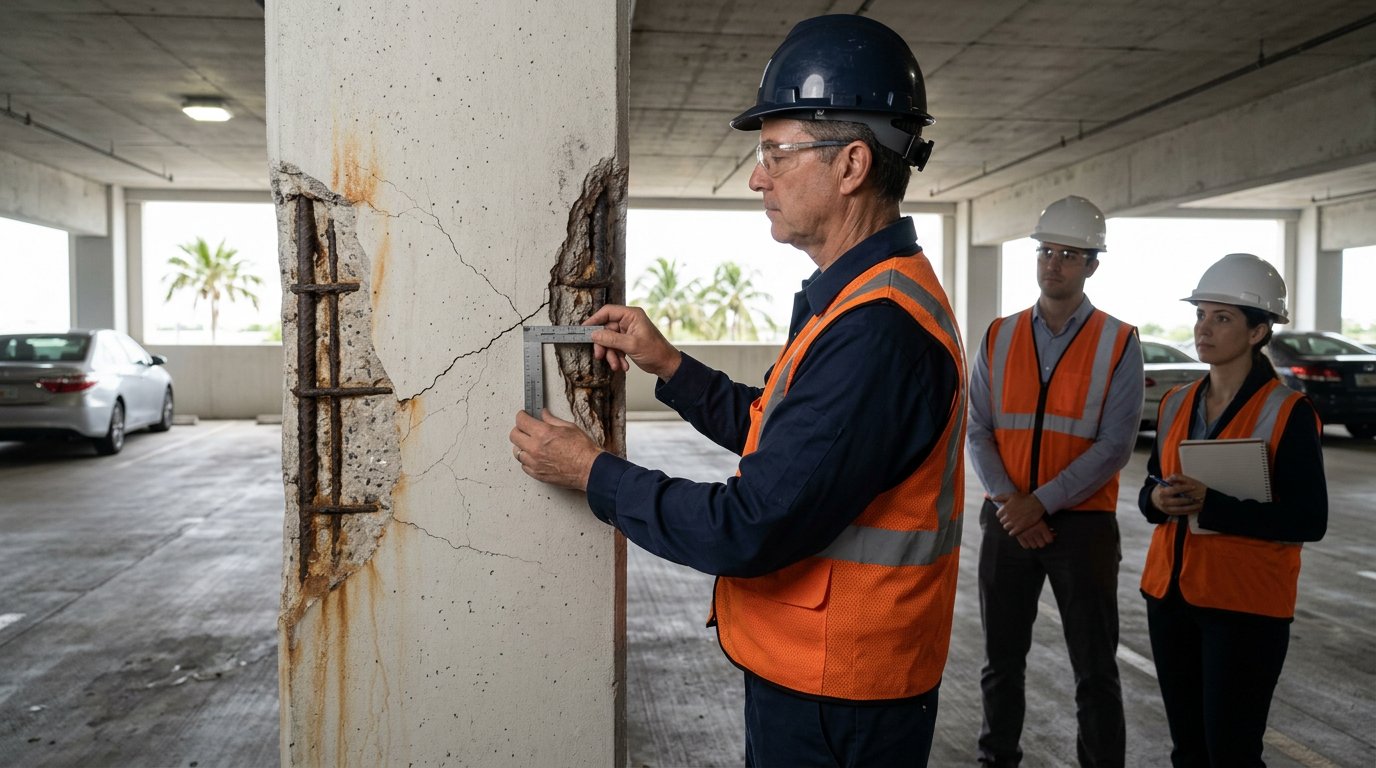
Site evidence documentation records each condition, location, and sample in context. Investigators use photographs, condition maps, and field notes to preserve observations. Records should specify inspection dates, environmental conditions, locations, and procedures. For example, a photograph of a cracked beam needs orientation and surrounding context, not just a close-up. This helps reviewers connect later interpretations to observed conditions.
Failure Analysis and Evidence Collection
Failure analysis uses collected evidence to assess how damage occurred and what factors contributed. Investigators compare visible distress with measurements, samples, and test results. Destructive or non-destructive testing may reveal concealed defects, while laboratory analysis can characterize materials. For a leak near a wall joint, the evidence should address the joint, nearby materials, and plausible water paths. This avoids relying on a single explanation that has not been tested.
A report should be prepared by an engineer whose education and experience fit the system and failure under investigation. The engineer should explain methods and reasoning objectively. For example, assessing structural damage calls for relevant knowledge of structural behavior and building materials.
Physical samples need clear labels and chain-of-custody records. Document who collected each sample, where and when it was collected, and each transfer or storage step. Pair sample records with orientation notes and time-stamped photographs. This connects tested material to its original location, especially when repairs could alter or remove evidence.
Federal Rule of Evidence 702 addresses expert testimony, according to United States Courts. A report should identify evidence, explain analytical methods, and show how each supports an opinion. Separate direct observations from interpretations so attorneys and reviewers can evaluate the scientific basis without mistaking inference for measurement.
What is forensic engineering and how does it apply to construction and infrastructure?
Forensic engineering examines how a building or infrastructure failure occurred and what factors contributed. Its technical findings can clarify disputed damage and inform insurance or legal analysis.
Investigations for Disputes and Claims
A forensic investigation applies engineering methods to identify damage mechanisms in construction disputes and insurance claims. This matters because competing accounts can obscure the cause and extent of a loss.
The analysis may distinguish among design compliance, installation deficiencies, and material performance issues. For example, an engineer assessing a recurring building leak can consider construction details, prior repairs, deterioration, and maintenance conditions. Each explanation is tested against the evidence rather than accepted at face value. Clear findings help property owners, insurers, and attorneys understand which conclusions the investigation supports.
Diagnostic Equipment and Investigation Techniques
Diagnostic techniques combine field observations with testing and analysis to evaluate a failure hypothesis. The chosen methods should suit the building element and the question being examined.
An investigation may use sampling, laboratory testing, historical analysis, or diagnostic modelling. Structural calculations and finite element analysis can help assess whether a proposed mechanism fits the observed conditions. In fire investigations, engineers may work with fire investigators to assess the ignition point, contributing materials, and construction-system performance. Explosion or electrical damage requires careful examination of affected components and material evidence. The report should explain the technical steps clearly so another expert can understand how observations informed the analysis.
Investigation Scope and Report Purpose
A forensic engineering report is a written account of an investigation’s scope, methodology, observations, analysis, and conclusions. It gives readers a structured basis for evaluating technical opinions and may support expert testimony.
Before fieldwork, the engineer defines the objective and technical scope. The report should disclose relevant limitations, such as restricted access or limits on destructive testing, because they affect what the investigation can establish. A summary report should also clarify when it provides less detail than a full analysis.
To choose a forensic engineer in your state, look for experience relevant to the building system and failure, plus the ability to explain methods and conclusions objectively. Attorneys and property owners can use an objective property damage assessment to clarify the technical issues at stake.
Review of records, drawings, and codes
Plans, permits, specifications, and maintenance logs help establish how a property was designed, built, and maintained. In a structural investigation, the engineer compares drawings with observed conditions and notes differences such as a changed connection or unrecorded repair. These records can clarify whether damage relates to original design, construction, later alterations, or deterioration. Dates and relevance matter: a maintenance entry made after a leak began cannot establish the building’s earlier condition.
Applicable codes and standards provide context for evaluating design and construction. In Florida, an investigation should reference the Florida Building Code applicable when the building was constructed. For an older structure, the engineer may also examine original design standards and codes. This avoids treating a later requirement as though it governed earlier work. The Council of American Structural Engineers published CASE 962-A, National Practice Guidelines for the Preparation of Structural Engineering Reports for Buildings. Industry-accepted references can support technical findings, while ANSI-prepared test procedures are typically considered acceptable in the U.S. court system.
Peer review and quality control assess whether the documentation supports the conclusions. A qualified reviewer can examine calculations, source records, test methods, and the connection between evidence and interpretation. For example, a review may reveal a calculation based on a drawing revision that does not match the permit file. Resolving that discrepancy before issuing findings improves clarity and helps the analysis withstand scrutiny during litigation.
Objectivity is essential throughout the review. The engineer should evaluate records that support competing explanations, including prior repairs, maintenance conditions, and material specifications. A missing drawing detail may limit what can be concluded, while a dated permit record may clarify when a change occurred. Documenting these distinctions helps readers separate established facts from assumptions. Thorough quality control also checks citations, figure labels, units, and whether each conclusion follows from the cited evidence rather than an unsupported inference.
Forensic engineering report organization
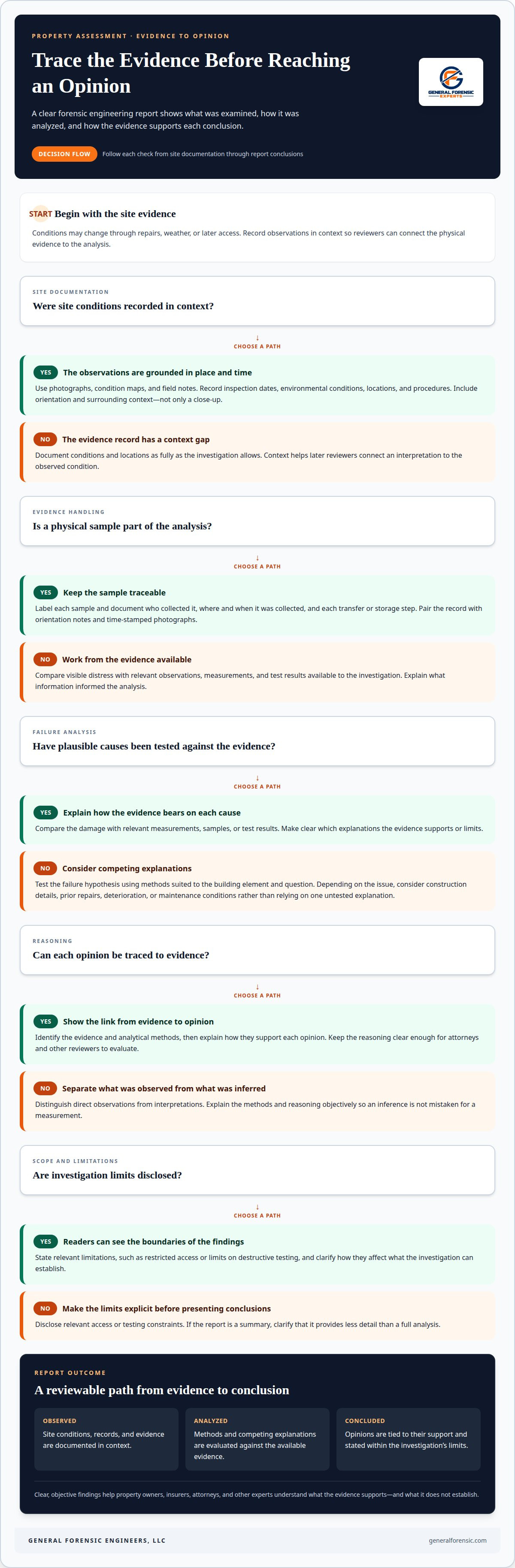
A technical document is easiest to evaluate when its structure follows the investigation’s logic. Begin with the purpose, scope, and materials examined, then present observations before analysis and opinions. This order helps attorneys, property owners, and adjusters distinguish documented conditions from interpretations. It also clarifies the central question: which conclusions follow from the evidence, and which fall outside the investigation’s limits?
Identify examined items, sampling methods and locations, test results with units, and procedures used for observations or calculations. A result without a unit, such as a material measurement, cannot be meaningfully assessed. A forensic engineering report should describe analytical steps so readers can follow how each finding supports an opinion. ASTM International identifies ASTM E620-18 as “Standard Practice for Reporting Opinions of Scientific or Technical Experts”. This reference underscores the importance of presenting technical opinions in a clear, reviewable form.
Keep factual data separate from interpretations, conclusions, and opinions. For example, first state that a measured crack appears at a documented location, then analyze its possible cause. Explain the calculations, assumptions, and evidence supporting that analysis. Label each conclusion clearly and connect it to the relevant findings. If the evidence supports more than one plausible explanation, describe the alternatives and explain why the analysis favors one, or why the available information cannot resolve the issue.
Use headings, figure references, and consistent terms to guide readers through the report. Cite a photograph, table, or calculation where it supports the discussion rather than leaving it disconnected in an appendix. State limitations near the affected analysis, such as restricted access to a concealed component. This helps readers assess how a limitation affects the conclusions without mistaking an assumption for an observed fact. Clear organization also supports consistency if the expert later gives testimony.
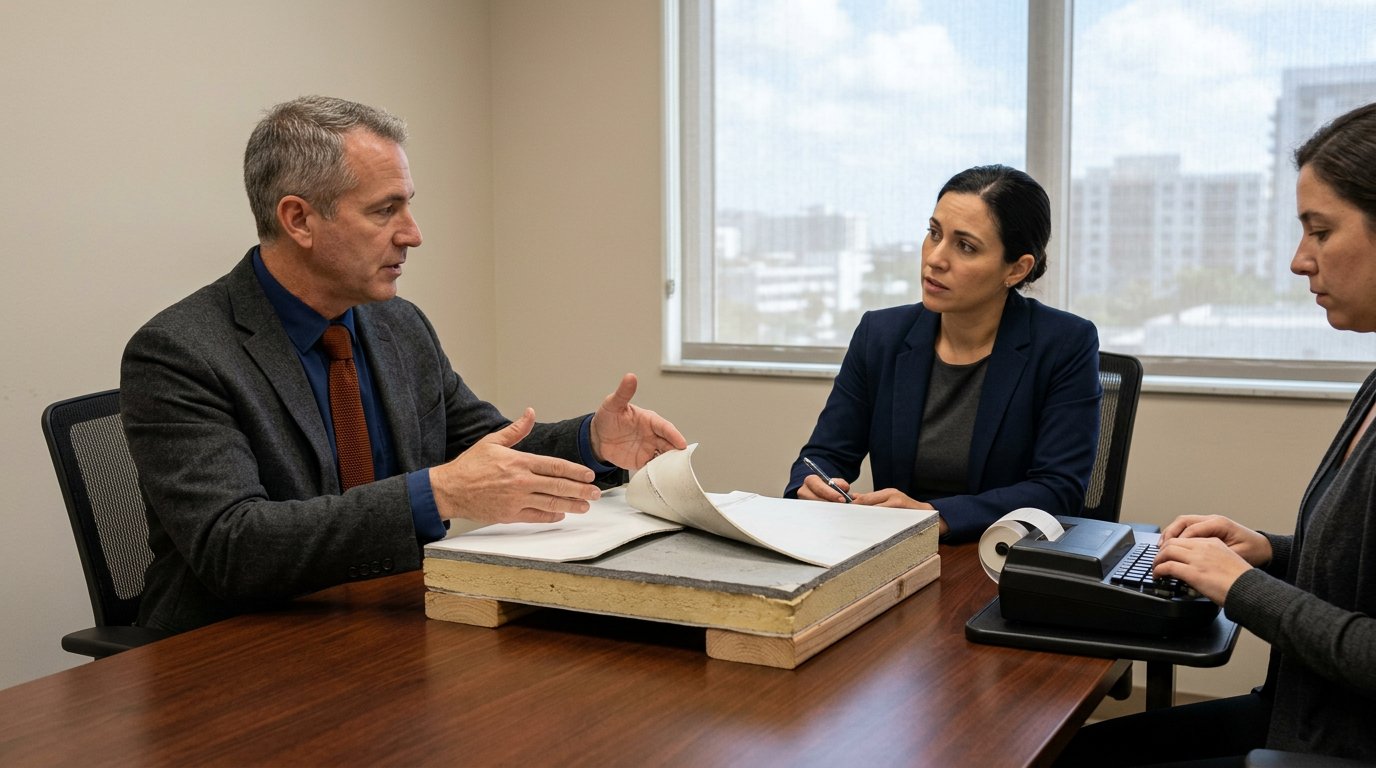
For attorneys assessing a disputed property condition, an organized forensic engineering report can clarify technical issues without substituting for legal advice. Discuss expert witness report needs when an independent technical analysis is required.
General Forensic Engineers
General Forensic Engineers, LLC helps property owners, commercial interests, and attorneys evaluate property damage through objective, evidence-based assessments. When damage raises questions about cause, extent, or contributing conditions, an Expert Forensic Damage Assessment can clarify the technical issues. Findings follow the evidence, whether it supports an initial explanation or points elsewhere.
Residential and Commercial Property Inspections can document property conditions, while Pre & Post-Commercial Property Hurricane Assessments address building condition around a hurricane event. For disputes requiring technical expertise, Expert Witness Services can support the presentation of engineering findings. These services help stakeholders distinguish observed conditions from opinions, without replacing legal advice or insurance claim adjusting.
Move from uncertainty to an informed next step
A property dispute can leave owners and attorneys weighing conflicting explanations. An independent technical assessment can clarify the condition at issue and identify which conclusions the evidence supports. A well-organized forensic engineering report gives stakeholders a clearer basis for deciding how to proceed, without predetermining the outcome.
General Forensic Engineers offers Expert Forensic Damage Assessment, Pre & Post-Commercial Property Hurricane Assessments, and Residential & Commercial Property Inspections. These services help property owners and legal professionals assess damage and building conditions through objective findings. The next step depends on the property concern and the questions requiring technical evaluation.
For a property matter requiring independent engineering insight, contact General Forensic Engineers to discuss an assessment. A careful, evidence-led evaluation can bring greater clarity to the decisions ahead.
Frequently Asked Questions
What are the key elements of a forensic engineering expert witness report?
Key elements include the assignment’s purpose, the materials examined, the investigation methods, and the engineer’s findings and opinions. A forensic engineering report should also identify assumptions, limitations, and supporting calculations. For an expert witness, the reasoning must connect each opinion to specific evidence. For example, a conclusion about roof failure should identify the observations, records, or test results that support it.
How can I make the report understandable for non-technical audiences?
Use plain language alongside precise technical terms, and define specialized terms when they first appear. Explain what measurements mean for the property rather than presenting figures without interpretation. Clear captions can describe what a photograph or diagram shows. For example, identify the pictured building component and explain its relevance to the analysis. Keep observed facts distinct from engineering opinions so readers can follow the reasoning.
How does the forensic engineering process work?
The process begins by defining the technical question and the property elements under review. The engineer then gathers relevant site information and records, selects suitable examination or testing methods, and analyzes the results. For instance, an investigation of recurring water intrusion may examine affected materials alongside building details and repair history. The work concludes with findings that address the defined question and explain the supporting analysis.
How long does it take to do a report?
The schedule depends on the investigation’s scope, site access, record availability, and any need for testing or laboratory analysis. A limited visual assessment involves different work from an investigation of concealed materials, multiple locations, or complex calculations. Report preparation follows the evaluation of relevant evidence. These project-specific factors shape the work sequence and the time needed to document findings clearly.
What is included?
A report typically identifies the assignment, the property or components examined, and the methods used. It may also present observations, test results with units, analysis, calculations, opinions, conclusions, and relevant limitations. Photographs, diagrams, or tables can support specific findings. For example, a table can organize measurements from several locations, while a caption explains where each image was taken and how it relates to the analysis.
What standards should I reference when writing a forensic engineering report?
Reference standards applicable to the methods, materials, and building conditions under examination. ASTM International identifies ASTM E620-18 as “Standard Practice for Reporting Opinions of Scientific or Technical Experts”. Structural reports may also draw on CASE 962-A. For a Florida building, consider the Florida Building Code applicable when it was constructed, rather than citing a code without regard to the construction period.

Comments